CZ EN Easy read

Menu


Builder's portal
In effect from 2026

One authority, one procedure,
one decision.

The amendment to the Building Act will help cut construction permitting from years to months. Less bureaucracy, clear accountability and a faster path to the buildings people need.

Modern residential development — visual for the new Building Act Building Act 2026
7–10years
to prepare apartment buildings today
12months
target for large projects
60days
target for family houses
1procedure
instead of dozens of opinions
News

Press releases and news

What's new around the Building Act amendment — press releases and news.

Second meeting of the steering committee for implementing the new state building-administration model
MMR · 18 June 2026 · News

Implementing the new building-administration model: steering committee confirms the next steps in the regions

The steering committee for the project implementing the new model of state building administration met for the second time. Initiated by Minister for Regional Development Zuzana Mrázová, the meeting focused on the current state of the project, the timetable of key milestones and progress in the regions — coordinators have already visited more than 275 municipalities and are collecting data on assets, IT and staffing capacity. The central element of the new system will be the Office for Territorial Development (URU); the nearest milestones include a decision on its seat, a July ICT action plan and the August finalisation of the 2027 budget.

Explaining the Building Act: heritage conservation deadlines
MMR · 18 June 2026 · News

Explaining the Building Act: deadlines for heritage authorities

The Building Act amendment does not shorten heritage-conservation deadlines — it merely explicitly splits the existing 30-day period for issuing a binding opinion. The National Heritage Institute will newly have 10 days for its assessment, with the remaining 20 days left to the state heritage authority to finalise the binding opinion. The powers of heritage conservation are preserved, and it now becomes part of the building administration. Government Commissioner for the implementation of building law Hana Landová explains the change on a podcast.

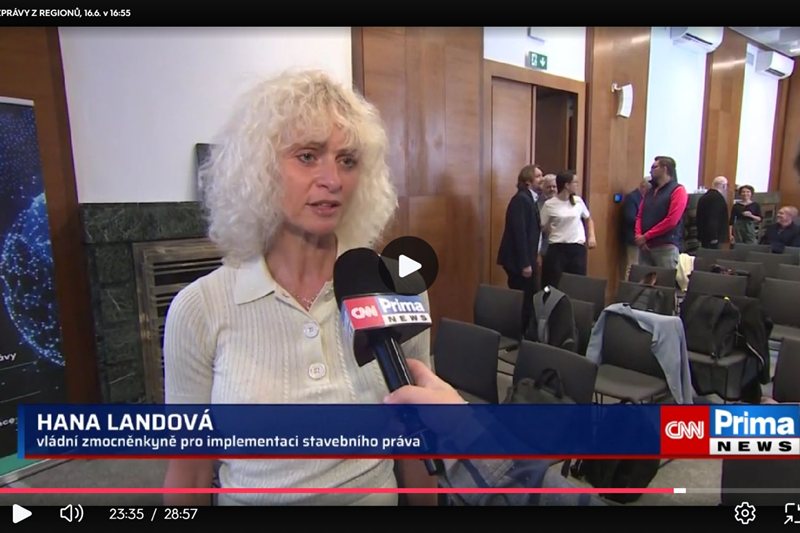
Hana Landová, Government Commissioner for the implementation of building law, in a CNN Prima NEWS report
MMR · 17 June 2026 · News

What the Building Act amendment will bring and what its benefits are

In a CNN Prima NEWS report from the Institut Strategeo conference, Hana Landová, the Government Commissioner for the implementation of building law, presented the main benefits of the amendment — faster construction permitting thanks to a single proceeding and a single decision, centralisation into a unified state building administration, and spatial planning now fully in the hands of municipalities. The changes are to take effect next year for large projects and from 2028 for smaller ones.

Hana Landová, Government Commissioner for the implementation of building law
MMR · 15 June 2026 · News

Explaining the Building Act: archaeological surveys will get deadlines

Under the Building Act amendment, archaeological surveys will get a fixed six-month deadline for work directly on the construction site — unless the archaeologists agree otherwise with the owner. According to statistics, more than 90% of finds are processed within six months, and the research itself then continues in laboratories with no time limit. Government Commissioner Hana Landová explains the change on the Agenda podcast by Seznam Zprávy Byznys.

Meeting of Czech construction industry leaders at Prague Castle
MMR · 4 June 2026 · News

The future of Czech construction was discussed at Prague Castle. The Building Act amendment was one of the topics

A meeting of Czech construction industry leaders took place at Prague Castle, attended by government representatives, construction firms, investors and experts. Zuzana Mrázová, Minister for Regional Development, presented the timetable for implementing the Building Act amendment, the build-up of the new state building administration and the launch of the New Building Act information portal.

Main changes

What specifically is changing

The top 4 principles of the reform. You will find all ten pillars of the Building Act amendment in the linked document.

01

One permit for the whole project

A single integrated decision instead of dozens of partial approvals.

02

Binding deadlines for authorities

60 days for family houses, 12 months for large projects — measurable and enforceable.

03

Strengthening the role of municipalities and regions

Real tools for managing the territory in the hands of those who know it best.

04

Priority for affordable housing

Apartment buildings as a public interest, just like motorways or schools.

Who it affects

What changes for you

Choose your role and see the main changes that directly affect you.

Expert reviews

Experts review the new Building Act

Myths & facts

What is said about the act — and how things really are

A brief confrontation of the most common claims with reality.

Myth

“The amendment will worsen nature protection.”

Fact

Nature protection remains in place. On the contrary, the amendment strengthens it by merging the separate opinions into one integrated process with clear accountability.

Myth

“Municipalities will lose their decision-making powers.”

Fact

On the contrary. Municipalities gain a stronger role in spatial planning and real tools to manage their own territory.

Myth

“Projects already under way will have to start over.”

Fact

Transitional provisions ensure that proceedings already under way will be completed by the original authority under the existing rules.

The path of change

The timeline and implementation, step by step

From the government priority, through the creation of the Office for Spatial Development, to responsible digitalisation. Click a step to expand the detail.

  1. 01 Starting point The Building Act as a government priority

    The implementation of the new Building Act is managed as a strategic project of the state. At the highest level it is overseen by a Strategic Committee chaired by the Prime Minister, with the participation of key ministries.

    In this way the state makes it clear that this is not a partial administrative tweak, but one of the priorities important for the economy, housing affordability and the development of municipalities. Faster and more predictable construction permitting is a basic precondition for more to be built in the Czech Republic — from family houses, through schools and kindergartens, to large housing and infrastructure projects.

    The new system is meant to bring a stable building administration, unified methodology and better sharing of capacity. Similar cases are to be assessed similarly, regardless of where a citizen or municipality files an application.

  2. 02 Legislation The legislative process: the legal basis of the change

    The first step is the legislative process. The Building Act amendment creates the legal framework for the establishment of the new building administration system, the integration of agendas and the transition to a more efficient permitting model.

    The point of the change is to remove duplication and overlapping competences. In most cases the builder should no longer go from one authority to another and obtain individual opinions on their own. The protection of public interests is to be concentrated directly into a single procedure, for whose result the building authority will be responsible.

    The legislation also sets up the creation of the Office for Spatial Development, the regional structures, the territorial offices, and the rules for transferring agendas, employees, files and documentation.

  3. 03 Preparation Expert work and preparation in the regions

    Alongside the legislative process, the implementation project itself is under way. It is managed by the Ministry of Regional Development and covers all the areas necessary for the practical launch of the new system.

    Expert groups work on the project, focusing for example on the delimitation of state administration bodies, the structure of the Office for Spatial Development, human resources, economics and financing, legislation, operations, cybersecurity, records management, ICT, integrated agendas and communication.

    The Ministry's regional coordinators also play an important role. They collect data on agendas, employees and offices, communicate with municipalities and regions, and help identify local risks and capacity needs. Thanks to this, the change is not prepared only from behind a desk, but with regard to the real situation in the regions.

  4. 04 2026 2026: preparing the new structure

    2026 is the preparatory phase of implementing the state building administration. During this period, the organisational, staffing, economic and technical conditions for the new building administration are being set up.

    The future structure of the Office for Spatial Development is being prepared, and the current distribution of building authorities, the volume of agendas, staffing capacity and the availability of services in the regions are being analysed. Part of the work is preparing the delimitation — that is, the transfer of agendas, employees, files and documentation into the new system.

    The goal is not an abrupt, unprepared change. Implementation is to proceed gradually, with an emphasis on continuity of decision-making, availability of services and stability for employees and citizens alike.

  5. 05 2027 2027: creating the Office for Spatial Development

    A key institutional milestone will be the creation of the Office for Spatial Development on 1 January 2027. It will become the central government body responsible for the building code.

    The Office for Spatial Development (URU) will provide methodological guidance for the entire building administration system and ensure a unified interpretation of the rules. This is a fundamental difference from the current situation, where the practice of building authorities can vary considerably across the country.

    Strong methodological guidance should bring greater predictability for builders, municipalities and officials. Officials are to have clear support in methodologies, model procedures and unified quality management.

  6. 06 2027 2027: integrating agendas

    With the creation of the Office for Spatial Development, the next phase begins: the integration of agendas from central government bodies, regions and municipalities.

    Integration is precisely one of the main principles of the reform. In the new system, the building authority is to concentrate the assessment of a project into a single procedure. This will reduce today's chaining of opinions, the repeated assessment of the same questions and the shifting of responsibility between authorities.

    For a citizen or municipality, this means simpler communication with the state. It should be clear who leads the procedure, who is responsible for it and when a decision is to be made.

  7. 07 2028 2028: the new building administration in the regions

    From 1 January 2028, the new structure of the state building administration is to begin operating in its full territorial layout.

    At the regional level, regional offices for spatial development will be created. Basic contact with citizens, municipalities and builders will take place through a network of approximately 205 territorial offices in municipalities with extended powers.

    The system may also include branch offices outside the seats of municipalities with extended powers. Their creation will depend on practical need — for example, travel distances, the volume of the agenda, the specifics of an area or staffing capacity.

    The goal is to create a professional, stable and methodically managed system that has sufficient capacity while remaining accessible in the regions.

  8. 08 People Officials: stability, methodology and better backing

    The success of the reform will also depend on the employees of building authorities. The new system therefore primarily envisages the transfer of existing officials from municipalities, regions and the authorities concerned.

    The transfer will be carried out according to the principle of predominant activity, with guarantees of remuneration and recognition of existing qualifications and experience. At the same time, capacity will need to be supplemented through new recruitment, the involvement of experts from the market and retraining.

    The new building administration is to offer officials clearer rules, unified methodology, shared capacity and better backing. This should help especially where smaller building authorities today run into a shortage of people or complex cases handled without sufficient support.

  9. 09 Municipalities Municipalities remain key to developing their territory

    The new system changes how the state building administration is exercised, but preserves the municipalities' fundamental role in spatial planning. Municipalities and regions are to continue deciding on the development of their territory, setting the rules in zoning plans and defending the public interest in quality development.

    The principle is simple: the municipality determines what and where is to be developed in its territory, while the state ensures, professionally and predictably, how the permit is processed.

    The zoning plan is thus to carry greater practical weight. If construction complies with the zoning plan and the basic questions have been assessed in advance, they should not be reopened for each individual building.

  10. 10 2028–2029 2028–2029: stabilising the system

    After the launch of the new territorial structure, a stabilisation phase will follow. In 2028 and 2029, the functioning of the new system will be verified in practice, the methodology fine-tuned, procedures unified and an assessment made of where the system needs to be further strengthened.

    This phase is important so that the change is not limited to a formal transfer of competences. The new building administration is to work as a single system: with unified management, shared capacity, clear accountability and greater predictability of decision-making.

  11. 11 2030–2031 Digitalisation: gradually and responsibly

    One of the key milestones will be the digitalisation of construction proceedings. The Ministry is proceeding so as not to repeat the problems associated with the unprepared launch of digital systems.

    Digitalisation is to be a tool that genuinely helps builders, officials and municipalities. It should not be another burden launched without testing and without a connection to practice.

    The Builder's Portal and the Construction Proceedings Information System will operate in maintenance mode until the end of 2030. As of 1 January 2028, existing software, records services and archives are to be integrated into the structure of the Office for Spatial Development. In 2030, testing of DSŘ 2.0 (the digital construction proceedings system) is to take place, with parallel operation in the first half of 2031 and exclusive operation of DSŘ 2.0 in the second half of 2031.

    A responsible approach is also being taken to the National Geoportal of Spatial Planning. The goal is not to pass further problems onto municipalities, but to verify the digital tools so that they are genuinely usable.

  12. 12 Goal The goal: a building administration that supports development

    The implementation of the new Building Act has one main goal: to create a building administration that is faster, clearer and more predictable.

    For citizens this should mean less paperwork and clearer rules. For municipalities, a stronger role in planning development. For officials, a more stable system and methodological support. For the economy, faster construction of housing, infrastructure and public buildings.

    The Building Act amendment is therefore not just a change of legal regulations. It is a path towards making the building code stop being an obstacle to development and start working as a service to citizens, municipalities and the whole country.

12 phases — from the government priority, through the creation of the Office for Spatial Development, to digitalisation.
Implementation in practice

News from the implementation

Key information from the newsletters on the introduction of the new Building Act. Click an item to open the full text.

Government Commissioner

Government Commissioner for the Building Act

Ing. Hana Landová — Government Commissioner for the implementation of building law
Ing. Hana Landová Government Commissioner

The Government Commissioner for the implementation of building law is appointed and dismissed by the Government of the Czech Republic on a proposal from the Minister of Regional Development. As of 26 January 2026, the Government Commissioner is Ing. Hana Landová.

Questions & answers

Frequently asked questions about the Building Act amendment

The Building Act amendment affects citizens, builders, officials, municipalities, regions and other players in construction. The questions are grouped by audience, so everyone can quickly find the answers relevant to their situation.

A Citizen

Getting a building permit in the Czech Republic often takes years today. For more complex apartment buildings, preparation and permitting can stretch to 7 to 10 years. The process is complicated, confusing and the outcome uncertain. That has a direct impact on housing affordability, construction prices and the development of municipalities.

The amendment aims to change this. Its goal is to speed up and clarify construction permitting, remove unnecessary administrative steps and set clear accountability for decisions. This is not another minor patch to the system, but an effort to create a more stable and predictable environment for citizens, municipalities, officials and builders.

Yes, and positively. The amendment simplifies renovations and smaller projects, cuts unnecessary paperwork and reduces the number of obligations that burden small builders today.

The goal is for ordinary home improvements not to be a bureaucratic marathon. For simpler projects, the process should be proportionate to their scale and risk, so people don't have to handle the same amount of paperwork as for complex large projects.

On the contrary. The system should be clearer and more predictable. Fewer parallel proceedings, fewer vague requirements and clearly defined responsibility of the authority mean that even people who build or renovate once in a lifetime will find their way around the process more easily.

It is important that a citizen knows what to submit, to whom, and when they can expect a result. The amendment therefore aims to ensure that a builder does not go from office to office, but handles their project in a single, understandable process.

No. The amendment does not introduce building without rules. It keeps the requirements for safety, the protection of public interests, compliance with the zoning plan and the technical requirements for buildings.

The change is that oversight should be proportionate, coordinated and not needlessly repeated. If a particular question has already been assessed in spatial planning, it should not be reopened at every further stage of the procedure.

Yes. The amendment does not take away neighbours' right to defend their property, privacy or living conditions. Neighbours will be able to raise objections if a building directly affects their rights.

The point of the change is for objections to be specific, substantive and filed on time. The goal is not to allow endless blocking of construction through general disapproval, but the ability to defend oneself against a genuine interference with one's rights must remain.

If a project affects ownership rights, access, sunlight, privacy or another specific right, the neighbour can object. But if someone raises general disapproval with no specific impact on their rights, that should not be a reason to unduly prolong the procedure.

Yes, judicial protection remains in place. The Building Act sets a one-month deadline for a lawsuit against a building authority's decision, running from the notification of the decision.

This deadline is important for legal certainty. If a project is to have a predictable timeline, it must be clear by when a decision can be challenged and when the matter can be considered settled.

The amendment does not change the substantive scope of the public's rights. The public has a key role in spatial planning, where it is decided whether and where to build.

Construction proceedings then deal mainly with the technical execution of a specific project, which must comply with the planning documentation. The goal is to curb obstruction tools, not meaningful public participation.

No. The protection of nature and the landscape remains in place. Some processes are integrated into the decision-making of building authorities, others remain within the competence of the authorities concerned — for example in sensitive areas or under special protection regimes.

The change is meant to prevent the protection of individual interests from being applied unpredictably, repeatedly or disproportionately. This is not a weakening of protection, but better coordination of it.

No. The protection of monuments remains in place. Historic centres, monument reservations, monument zones, immovable monuments and their buffer zones remain under a special protection regime.

The amendment is meant to make processes clearer and set clearer accountability for decisions. The goal is not to allow insensitive interventions, but to ensure that the protection of cultural heritage works expertly, predictably and within reasonable deadlines.

Illegal buildings are not permissible under the new act either. However, the amendment better distinguishes between a serious breach of the rules and a less serious lapse.

The goal is to act firmly where necessary, while avoiding disproportionately harsh sanctions in cases where they would make no sense. Simplifying the legal route should also reduce the incentive to build without a permit.

Yes. The amendment strengthens the principle of protecting good faith. People do not understand why they should bear the harshest consequences — for example the threat of having a building demolished — if they themselves broke no rules and bought the property trusting that it had been duly permitted.

The law should distinguish between the actual culprit and a person who became the victim of a system error or of their legal predecessor's conduct. This is not an excuse for illegal buildings, but a fairer assessment of specific situations.

Yes. Building law should be able not only to oversee, but also to help quickly. After natural disasters it is important that people can return to normal life and restore their housing without unnecessary delays.

The amendment therefore allows faster procedures where recovery makes sense and there is no risk of repeating the same problem. The goal is a practical system that helps people in crisis situations.

Parcel lockers for delivery services are to be explicitly classified among minor structures in the free regime — that is, without the need for a building permit.

Installing them is to remain administratively simple, but basic rules — for example for safety, access or connection to infrastructure — still apply. They must also be built in line with the zoning plan. The goal is a clear and uniform solution for municipalities, operators and citizens.

B Builder

The principle of “one procedure, one authority, one decision”. The builder no longer has to go from office to office collecting individual stamps with no clear accountability for the result.

The amendment is meant to replace the chaining of opinions with one coordinated process. The builder should have a single partner, clearer deadlines and a more predictable outcome.

The speed-up should come mainly from removing duplication. What has already been — or should have been — assessed in spatial planning should not be assessed again in the construction proceedings.

At the same time, deadlines are reinforced, the opinions of the authorities concerned are integrated, and the building authority's responsibility for the final decision is set out more clearly. The goal is to reduce the number of cases sent back, repeated requests for additions and procedural loops.

It means that a project is to be assessed according to the factual and legal situation as of the day the application is filed. This is crucial for the builder's legal certainty.

Today it can happen that during a long procedure the conditions change, the documentation has to be reworked, recirculated and reheard. A fixed decisive date is meant to prevent the procedure from endlessly returning to the start because of changes the builder could not have known about when filing the application.

Yes. The amendment envisages that, together with the application, the builder may also submit a draft decision, including its reasoning.

It does not mean the builder decides for themselves. The decision is always made by the building authority. But for well-prepared applications such a draft can help considerably, because the authority gets a structured basis and does not have to create everything from scratch.

The amendment sets responsibility more clearly where it belongs. The designer and other authorised persons are responsible for the correctness and the fulfilment of technical requirements in the project documentation.

The building authority should not be a co-designer. Its task is not to professionally recalculate every specialised part of the project, but to assess the legality of the project, the protection of public interests and compliance with what it is supposed to evaluate under the law.

No. It means a better division of responsibility. The professional guarantee for the technical parts of the documentation is borne by an authorised person who carries professional liability.

This allows the authority to focus on what is its role: legality, public interests, procedural correctness and the project's compliance with the requirements of the law. This should increase both the quality and the speed of decision-making.

It is necessary to distinguish between the authorities concerned and the owners or operators of public transport and technical infrastructure. For the authorities concerned, the Building Act assumes they generally have 30 days to issue an opinion or binding opinion; in complex cases the deadline can be extended.

If they do not respond within the deadline, deemed consent without conditions may take effect under the conditions set by law. However, this does not apply in certain sensitive environmental cases, such as EIA, where the law explicitly excludes deemed consent.

For operators of public transport and technical infrastructure, it is legally inaccurate to claim automatically that the same deemed consent applies in all cases as for the authorities concerned.

Even here, though, the amendment is meant to reinforce deadlines and predictability. Network operators are to respect the deadlines for their opinions, typically 30 days and in particularly complex cases 60 days. The key point is that the builder does not wait indefinitely.

Simplification does not mean weaker safety. With fire safety, the goal is to simplify the process, not the standard of protection.

The fire service has reassessed the scope of its requirements for buildings, documentation and the way matters are handled. Buildings and processes should be better differentiated according to fire risk. For simpler buildings and projects with minimal fire risk, an administrative simplification of procedures is expected, while for buildings with higher fire risk the application of fire-protection requirements remains essential.

A binding opinion from the state fire-supervision authority remains in place for buildings where the fire risk is significant. These are typically tunnels, hospitals, shopping centres or other buildings that are difficult to evacuate in the event of a fire.

The change therefore does not concern the standard of protection, but the smoothness of the procedure and the removal of unnecessary administrative steps where the risk is not high.

Yes. The amendment strengthens the use of authorised inspectors. Already today, an expert report by an authorised inspector can be attached to the application, certifying that the building matches its permit, is fit for use and meets construction requirements.

The amendment allows authorised inspectors to issue the final approval decision as well. This can significantly speed up the final stage, which is often crucial for builders because of mortgages, the land registry or dealing with the property.

Proceedings already under way will be completed under the transitional provisions, so they are not needlessly complicated or sent back to the start.

The goal is a smooth transition, not a halt to ongoing projects. If some administrative procedures are abolished by the amendment, they will be discontinued, or their usable parts will be used in further decision-making.

The goal is the exact opposite. Today the biggest source of disputes is the lack of clarity, inconsistent practice and the repeated procedural sending-back of cases.

Clearer rules, fewer obstructions, firmer accountability and an emphasis on proportionality should reduce the incentive for tactical disputes. Judicial protection remains in place, but the system should be more predictable.

It is the principle that if a project can be adjusted to meet the legal requirements, the building authority should preferably set conditions and issue the permit rather than reject the application outright.

This is not a novelty that circumvents the law. The legal order already knows a similar principle. The amendment explicitly confirms and clarifies it. If the conditions cannot be met, the application is of course rejected.

The amendment sets a basic time frame of 6 months for the field part of an archaeological survey before construction, with the option to extend it by agreement.

The goal is greater predictability. Today surveys can take an unpredictably long time, which complicates investment planning, the booking of construction capacity and the drawing of subsidies. The protection of archaeological heritage remains in place, but the process should be more manageable in time.

C Official

The goal is to simplify officials' work, not add more bureaucracy. The amendment removes duplicate processes, repeated assessments and unclear boundaries of responsibility.

Officials should have clearer methodology, stable backing and a more understandable process. Reducing paperwork should help officials focus on the genuinely essential assessment of a project.

Responsibility will be borne by the building authority as a whole. This should increase the clarity of decision-making and end the shifting of responsibility between individual bodies.

Clear responsibility is important for builders and for the officials themselves. Everyone should know who is to handle the matter, at what stage and with what outcome.

The designer is responsible for the correctness of the project documentation and for meeting the technical requirements. If they cannot prepare a particular part themselves, they must bring in a specialist who is responsible for their part.

At the same time, the designer is not responsible for deviations that arose during construction without their consent. The amendment thus more precisely distinguishes what is the designer's responsibility and what is the role of the building authority.

Yes. Implementation is to proceed in a managed way, with methodological support and in cooperation with ministries, municipalities, regions and other players.

Part of the preparation is communication with local governments, building authorities, municipal secretaries, regions and the officials themselves. The goal is for the transition not to be abrupt and for officials to have timely access to information, methodology and contacts for resolving practical questions.

The current system already runs into staffing problems today. Some authorities are chronically understaffed and a large share of officials are at or near retirement age. The new system is meant to enable the sharing of capacity, interchangeability and unified methodological support.

The act is therefore designed to simplify the system, not burden it. Fewer duplicate steps and clear responsibility should reduce the demands on capacity.

Building authority officials are meant to be a key asset of the new system. The reform aims to create a more professional and stable environment in which officials will have clearer methodology, better interchangeability and professional backing.

The transition is to take place gradually, in accordance with labour-law rules and with regard to the practical functioning of the authorities. The goal is not to lose experienced people, but to give them more stable conditions for handling a demanding agenda.

This question is part of the implementation project. It addresses the transfer of files, digitalisation and the setting of unified procedures so that the continuity of records of construction documentation is not disrupted.

The goal is a well-thought-out transition that takes into account the practical impacts in the regions and allows authorities to continue working without losing documentation or procedural continuity.

Speed is not a goal in itself. The goal is to remove unnecessary delays, duplication and repetition.

On the contrary, the quality of decision-making should improve, because relevant interests are assessed in a coordinated way, responsibility is clearly defined and authorities receive more unified methodology.

The selection procedures will be open and transparent. The employee will hold two relationships at the same time: a service relationship as director of the regional Office for Spatial Development or head of a territorial office, while at the same time still being an employee of the relevant municipality or region, where they will continue to carry out the agenda of the building authority under delegated powers. Candidates apply for the selection procedure voluntarily; in order to ensure motivation and to compensate for the time commitment, the Act provides for the possibility of drawing a salary at the regional Office for Spatial Development and concurrently from the current employer.

Given that neither the regional Office for Spatial Development nor the territorial office will be established in 2027, the director or head will, in this role, take part in the organisational activities of the office. At the same time, it must be mentioned that in many cases no overlap need occur at all if a new manager is selected.

We guarantee that existing conditions will not deteriorate. Total remuneration, i.e. the base salary and the personal bonus, will be preserved. The pay grade and step do not change, but in practice they will increase, since the pay table under Government Regulation No. 304/2014 Coll. is higher than the pay table for self-governing units under Government Regulation No. 341/2017 Coll.

The personal bonus remains at the same amount, but at the same time its sum with the base salary is not to be higher. At the same time, however, it is guaranteed that the personal bonus will not be reduced by the amount by which an employee's base salary increases as a result of being placed in a different pay grade or step or as a result of salary indexation.

The decisive factor will be the predominant scope of work. If an employee mainly performs an agenda that is being transferred to the state building administration, they will transfer together with this agenda under the rules of the Labour Code. For mixed workloads, for example a 50-50 split, individual cases will be addressed on a case-by-case basis. The aim is to find a solution between the new management of the state building administration, the existing employer and the employee concerned, so as to ensure both the performance of the agenda and fair working conditions.

If the agenda does not predominate, the transfer will not be automatic. However, even in these cases an employee may express an interest in working in the state building administration, and the situation will be addressed according to the needs of the system and the possibilities of the given office.

If an employee primarily performs an agenda that is transferring to the state, the transfer of rights and obligations will take place by operation of law under Section 338 et seq. of the Labour Code. The law guarantees that the existing total remuneration is maintained.

In more complex situations, the procedure will be addressed individually, particularly where an employee performs several different agendas or where the predominant part of their work is not clearly tied to the building administration. The implementation will also include communication and recruitment, so that the new offices are adequately staffed and so that the experience of existing officials can be put to use.

The number of transferring employees will not be determined mechanically in advance. The basic criterion will be the predominant exercise of the agenda being transferred to the state building administration.

Officials from the authorities concerned, for example in the environmental field, will not automatically become officials issuing the entire building permit after integration. They will continue to exercise their expertise as specialists in a particular protected public interest. Their expert output will then be taken up by an official of the building authority, who conducts the proceedings and issues the resulting decision.

In 2027, the integration of the agendas concerned will mainly affect the Office for Spatial Development, that is, in particular reserved constructions and methodological activities. At the territorial level, the new integrated model will not become operational until 1 January 2028.

Until then, municipal and regional building authorities, as well as the authorities concerned at the territorial level, will in principle proceed in the existing manner. In 2027, binding opinions and other opinions will be issued where required by the rules in force for the transitional period.

The motivational and personnel tools are not set out in detail directly by the Act. They will form part of the implementation, the management of the new authorities, and human resources work.

In 2027, both municipal and regional building authorities will continue to operate, as will the authorities concerned in the territory. Organisational changes to regional and municipal building authorities will not take effect until 1 January 2028.

One official will not carry out the entire process. The protection of interests will be assessed by an integrated specialist, and only then will the building authority official who conducts the proceedings build on the specialist's output.

The rule is that the agenda is always carried out by an official who has passed the appropriate special professional competence examination or civil service examination, with an official being permitted to carry out only those activities for which they are authorised.

In spatial planning, too, the prevailing nature of the work will be decisive. At the same time, an important exception applies: the preparation of planning documentation is to become an independent power of municipalities and regions.

Employees who will prepare planning documentation for a municipality or region under independent powers will therefore remain employees of that municipality or region. Those whose agenda is to be transferred to the state building administration will be dealt with under the rules for the transfer of agendas.

It depends on the specific activity. The preparation of planning documentation for municipalities and regions will newly fall within their independent powers. These activities will therefore be carried out by municipalities and regions.

The state building administration will perform only those spatial planning activities that remain with it or are entrusted to it under the new legislation. The specific arrangements will form part of the implementation.

The basic guarantee is that the transition will not worsen officials' salary conditions. In addition, the new system is to offer a more stable environment, unified methodological support, better substitutability and a clearer division of responsibility.

The aim is not to transfer more uncertainty onto officials, but on the contrary to create a professional state building administration in which individual authorities will not be isolated and overburdened without the possibility of sharing capacities.

Yes, provided that the prevailing part of their work consists in carrying out an agenda that is transferring to the state building administration. The transfer therefore does not concern only officials who have passed the special professional competence examination, but employees in general who participate in carrying out this agenda.

Administrative staff do not thereby automatically become authorised officials for deciding on building matters. They will carry out activities corresponding to their job classification and qualifications.

Special professional competence examinations will continue to take place in 2027, with all officials having their current qualifications recognised upon transfer. For new employees in a service relationship (from 1 January 2028), the rule is that they must pass the civil service examination.

At the same time, it is assumed that special professional competence examinations will still be taking place at the beginning of 2028, provided that the employee registers towards the end of 2027 so that they are not deprived of their rights and have the opportunity to sit the regular examination date, or a resit date if necessary.

No. The qualification requirements are governed by the Building Act, whereby an official from an authority concerned who does not have the civil service examination or the special professional competence examination required to perform the agenda of a building authority cannot be an authorised official issuing permits for projects.

This employee will be integrated as a specialist in the protected public interest for which they are qualified by their special professional competence examination, and they will continue to ensure this activity within the Office for Spatial Development.

The exact number of employees being transferred will not be determined by a single blanket figure. The basis will be the predominant performance of the agenda that is transferring to the state building administration, and the specific needs of the individual offices.

Part-time positions will be handled in accordance with the general rules on the transfer of labour-law relationships and on the basis of management decisions.

Some areas of expertise will not need to be available separately at every territorial office. If a particular protected public interest needs to be assessed only in a smaller number of cases, the specialist may be assigned, for example, to a regional office, and the territorial offices will draw on that expertise as needed.

The aim is to share capacity more effectively, to ensure expertise, and at the same time not to burden every office with positions that would not be used efficiently at that location.

The amendment is set to take effect in stages. From 1 January 2027, the Building Act as amended will begin to apply, but the authorities concerned will only be integrated within the territory once the regional and territorial offices are established.

In practice, this means that in 2027 the current regime for issuing binding opinions and other opinions will remain in place within the territory. The full organisational change of the territorial building administration will only take effect from 1 January 2028.

The number of positions will not be determined merely by a blanket figure. It will be based on the scope of the agendas being transferred, on the predominant nature of the employees' work, and on the needs of the individual offices.

The specific configuration of capacities will form part of the implementation of the new structure of the state building administration.

In 2027, the authorities concerned in the territory will continue to operate and will issue binding opinions and other opinions under the rules of the transitional period. The full integration of the relevant agendas into the regional and territorial offices will only take place once those offices are established.

Proceedings and procedures that are not completed before the new offices are established and for which the competent authority changes will be taken over and completed by the relevant regional Office for Spatial Development or its territorial office. Until then, the existing competent authorities and the authorities concerned will continue to operate.

D Municipality & region

It means that spatial planning will be more strongly tied to self-governing responsibility. A municipality or region is to decide how its territory should develop, which needs of residents it should meet and which values it should protect.

Until now, drawing up planning documentation was more tied to delegated powers. The amendment changes this model so that local governments have more direct control over the development of their territory.

The municipality remains a party to the proceedings and can raise objections on matters related to the zoning plan, the development of the territory and the protection of values within its independent powers.

At the same time, the importance of spatial planning is strengthened. The municipality is to set the development concept — that is, what should happen in the territory and where. The state building administration then assesses the specific project expertly, under the law.

No. Local knowledge is preserved through municipal spatial planning and the municipalities' participation in proceedings. Officials are to continue working in the regions, and where it makes sense, branch offices can be set up.

The goal of the change is not to limit the influence of local governments, but to remove the fragmentation of the system and unify decision-making methodology.

The plan is to create the Office for Spatial Development, 14 regional development offices in the regional capitals and the City of Prague, and 205 territorial offices in municipalities with extended powers. Branch offices in further municipalities will be set up as needed.

The aim of the new structure is to unify methodology and decision-making practice, eliminate systemic bias, reduce jurisdictional disputes and enable the sharing of capacity.

The number of authorities alone is no guarantee of a functioning system. Today the system suffers from a shortage of officials, divergent practice, jurisdictional disputes and inconsistent interpretation of the rules.

The new system is meant to enable the sharing of capacity, interchangeability, more stable methodology and more consistent decision-making. What matters is not only that an authority is physically close, but that it decides expertly, predictably and within statutory deadlines.

Branch offices beyond the basic network of territorial offices are to be set up according to the needs of the area. Economic, staffing and capacity efficiency, as well as demand from municipalities, are to be taken into account.

The point is to maintain accessibility where high-quality handling of the agenda can be ensured, not to mechanically keep a structure regardless of staffing and professional capacity.

Yes. It is municipalities that often run into the same barriers as private builders: long proceedings, uncertain outcomes, repeated requests for additions and the inability to complete a project within a subsidy period or an electoral term.

Faster spatial planning, clearer rules and more predictable permitting are meant to help municipalities prepare schools, kindergartens, health and social facilities, affordable housing and transport and technical infrastructure.

The amendment drops some unnecessary formal steps and allows a faster procedure for changes that do not interfere with the concept of the zoning plan. Minor changes in developable areas should be possible within a matter of months.

The goal is that municipalities do not have to go through a lengthy process — which today can take years — for minor corrections, refinements or specific needs.

This is the municipality's option to clarify questions of interpretation or to agree to a minor deviation in cases where no public interests are affected and the affected owners and eligible investors agree.

This could be, for example, a practical refinement in the area that does not change the meaning and purpose of the zoning plan, but makes it possible to reasonably permit a specific project without the need for a lengthy change to the planning documentation.

The amendment strengthens planning contracts and the ability to address, in a predictable way, the impacts of new construction on public infrastructure and the municipal budget.

If new development creates a need for pavements, sewerage, transport, school capacity, greenery or services, it should be possible to address these costs and obligations transparently and on time. The goal is a fair relationship, not ad-hoc bargaining.

The amendment envisages tools that will allow municipalities to respond better to situations where a change to the planning documentation increases the value of land.

The point is for territorial development to bring a fair benefit to the municipality as well, since it has to provide public infrastructure and services for new residents or users of the area.

The aim of the reform is to transfer the performance of the building administration to the state and to end the situation where municipalities subsidise the performance of state administration from their own budgets.

The specific arrangement of financing, compensation and operating costs is part of the implementation preparations. Employment-law questions are to be handled according to standard rules.

The implementation includes a project team and a network of regional coordinators. They are to communicate with local governments in the regions and help resolve specific issues — staffing, organisational and technical.

Municipalities should thus have specific contacts with whom they can resolve their questions directly. The goal is for the transition to the new system to be not just a formal change of law, but a genuinely managed process.

The amendment provides a safety net for municipalities that do not want to, or cannot, draw up a zoning plan on their own. In such a case, the municipality can reach an agreement with another municipality, the region or a qualified provider, or with an association of municipalities (whose status was adjusted precisely to enable this option). A municipality can also ask the regional Office for Spatial Development, which is obliged to draw up the zoning plan for the municipality at its own expense.

The goal is to strengthen local governments, while at the same time not leaving smaller municipalities without professional help.

E System, implementation and public interests

The amendment does not arise in a vacuum. It builds on several years of expert debate about building law and responds to problems that piecemeal adjustments have long failed to solve.

At the same time, the legislative process allows for comments, committee discussions, amendments, debate in the Senate and the President's signature. The final form of the act emerges within the standard parliamentary process.

A private member's bill is a legitimate route that the legal order allows. It does not mean circumventing debate. The bill is discussed in Parliament and can be amended within the standard legislative process.

The reason is the urgency of the situation. Preparing an entirely new government bill would mean losing further years at a time when construction permitting is one of the main barriers to affordable housing and the development of municipalities.

Yes. The bill was refined and supplemented based on the debates. The discussion showed where the system gets stuck most in practice and where the legislative text is unclear or confusing for practitioners.

The basic direction does not change: the goal is faster, more predictable and less administratively burdensome construction permitting. But the resulting text reflects more of the practical comments from ministries, local governments, building officials, municipal secretaries, the professional public and citizens.

Inspiration from Poland is not about mechanically copying provisions. It is about learning from an approach that managed to reduce unnecessary delays, set responsibility more clearly and shrink the room for procedural chaos. Indeed, in 2025 the OECD (Organisation for Economic Co-operation and Development), comparing the Czech Republic and Poland, also noted that the changes in Poland point in the right direction for Czech building law too.

The Czech system must match Czech legal and administrative conditions. The point of the comparison is to show that faster and more predictable construction permitting is not unrealistic, provided the state sets clear rules and accountability.

No. The act sets rules for all builders: citizens, municipalities, regions, the state, public investors, small builders and larger projects alike.

Large investors can often handle a complex system with advisers and lawyers. An ordinary citizen, a municipality or a smaller builder is often lost in today's system. Simplifying the processes therefore helps precisely those who do not have the capacity to spend years going from office to office and dealing with repeated requests for additions.

Housing unaffordability is one of the biggest problems in the Czech Republic. The supply of flats is a basic precondition for housing to become more affordable.

Including mass housing among the public interests does not mean that any residential building automatically takes precedence over everything else. It means that the need for housing is to be taken into account in decision-making as a significant public interest and fairly balanced against other protected interests.

Not automatically. Housing is to become a significant public interest, but the protection of nature, the landscape and monuments remains in place.

The goal is to balance public interests, not to replace one interest with another. If there is a way to adjust a project through conditions while also protecting the values of the area, a solution should be sought instead of automatic rejection.

This is not a weakening of public interests, but a change in the procedural regime. Many public interests are to be assessed in an integrated way within a single procedure. In some sensitive areas — for example monuments or specially protected areas — special regimes remain.

The authorities concerned are to raise their requirements on time, proportionately and clearly. The goal is for public interests to be protected effectively, not repeatedly and unpredictably.

Corruption risk is reduced primarily by transparency, traceability and clear accountability. A fragmented system with many partial steps, paper files and unclear deadlines is not automatically safer.

A more unified process, a digital trail, a clear deadline and an accountable authority can increase oversight. What matters is that it is clear where a file is, who is handling it and why any delay is occurring.

Because a digital system has to work. Experience from past years has shown that unprepared digitalisation can paralyse the whole system instead of helping.

Digitalisation should be a tool for speed and transparency, not another obstacle. That is why the systems need to be prepared, tested and rolled out so that they help officials, builders and municipalities.

Responsible digitalisation is not about launching a system at any cost. It is about launching a functioning tool that genuinely helps people and authorities.

The goal is a modern, stable and tested digital system that reduces paperwork, increases transparency and enables better oversight of the course of proceedings.

Faster and more predictable permitting means more investment, faster construction and lower costs caused by time and uncertainty. This feeds into housing affordability, the development of municipalities and the competitiveness of the whole economy.

Every year of delay means higher costs for builders, municipalities and the state. If the preparation of construction can be shortened, it will save not only private money but also public funds.

The amendment is built on practical experience and on an emphasis on implementation. What is crucial is not only the adoption of the act, but also methodological work, training, ongoing evaluation and support for authorities.

But the current situation already creates serious problems: staffing instability, long deadlines, looping processes and low predictability. The reform is meant to address these risks systemically, not just cosmetically.

We found nothing for this term. Try other keywords.

Follow us

On this website you will find up-to-date and verified information on the amendment to the Building Act. We share further news on our social media.